Location
Washington, DC · Zone 7b
 Longview
A compact city lot designed as a layered native plant community — four-season interest, dense planting, and adding to the existing trees and shrubs.
The existing Magnolia kobus set the tone for the whole site — a structural canopy with a calm, established presence the design had to defer to rather than compete with. From there, the plan layers in a small understory tree (Cercis canadensis 'Merlot') for spring color, structural shrubs (Itea virginica 'Little Henry') for fall foliage and summer fragrance, and a deep ground-layer of native perennials, sedges, and grasses underneath.
Galanthus, Crocus, Narcissus, and Alliums carry color from February through June before the warm-season perennials and grasses take over. The whole design is built to fill in densely over two to three seasons — eventually suppressing weeds on its own — and to read as something deliberate from the curb without ever feeling fussy.
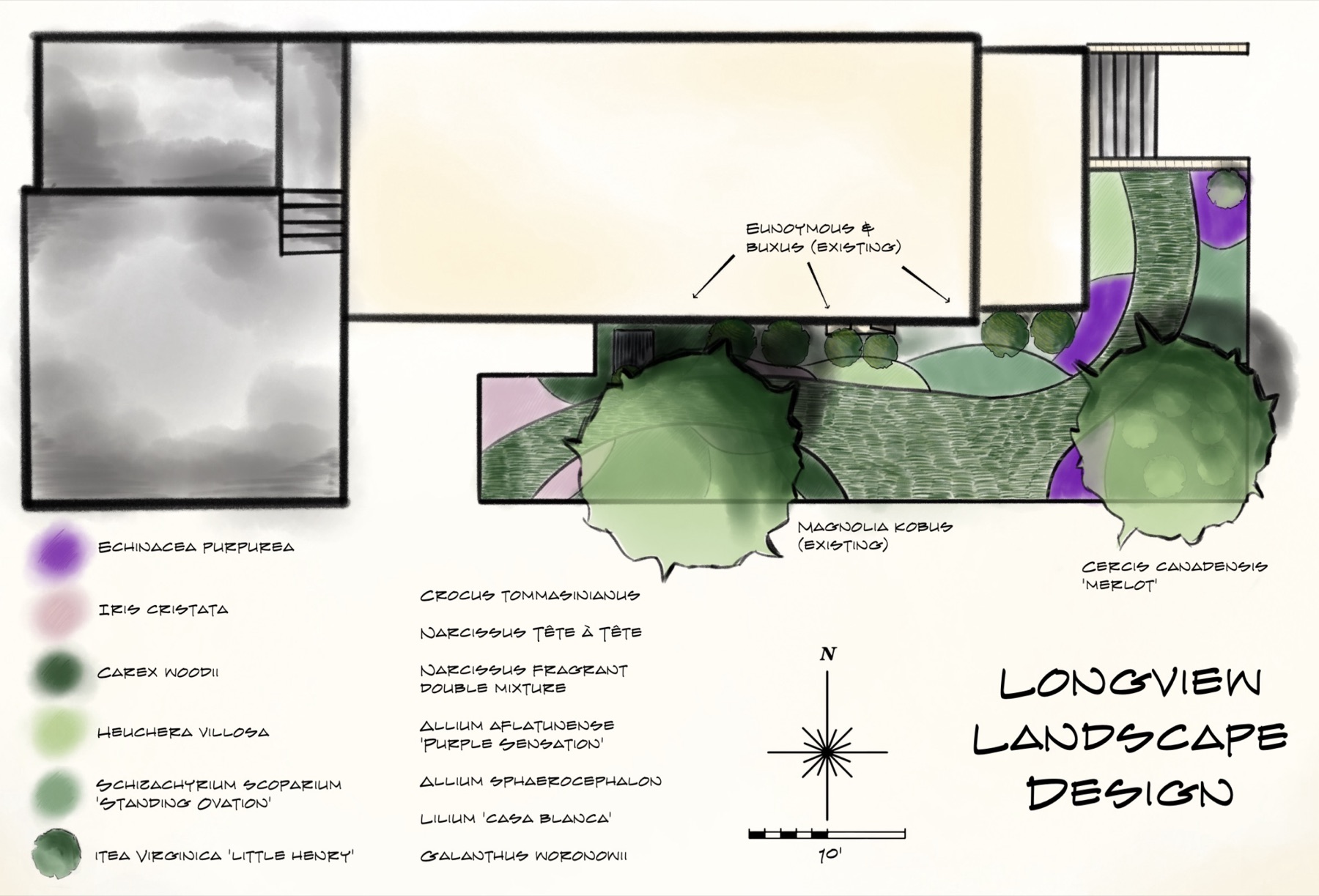
The season opens slowly, then builds — small bulb color through February, redbud and iris through April, alliums into May and June.
The warm season palette: bold native perennials carried by quiet ground-layer texture from sedge and grass.
When the native shrubs and grasses turn, the whole composition shifts to warm tones — and the seedheads of summer become winter's first form.
The garden holds itself through winter on structure alone — and then the snowdrops emerge on warm days in January.